
Popular Searches
Popular Searches

How to Select Compact Ball Valves for Irrigation, Horticulture and Industrial Systems
Compact ball valves are used in a range of fluid-handling applications where space, installation flexibility and flow control need to be considered together.
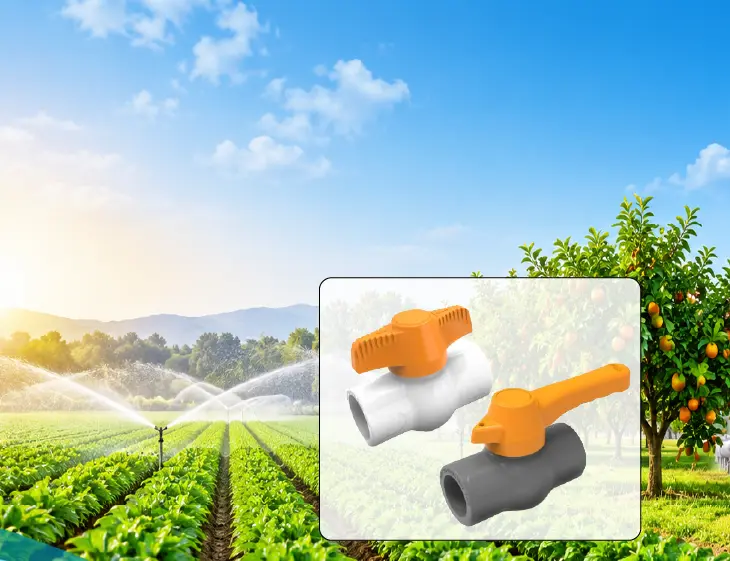
Compact ball valves are used in a range of fluid-handling applications where space, installation flexibility and flow control need to be considered together. Although their smaller dimensions can make them suitable for installations with limited clearance, valve selection still depends on the operating conditions of the system. Irrigation, horticulture, and industry can all have very different requirements of pressure, flow capacity, compatibility of fluid, material, and frequency of operation. Understanding these factors helps in choosing a compact ball valve that meets the installation's requirements while allowing for reliable operation and maintenance.
Why consider a compact valve?
Pipework can get surprisingly crowded, particularly around irrigation head units where several connections come together. A valve that takes up less room can make the arrangement easier to accommodate, provided there is still enough clearance to operate its handle.
This is where a Plastic compact ball valve can be useful. Its smaller construction suits installations where space is limited, without changing the basic purpose of the valve, which is manually controlling or shutting off the flow of water.
Of course, a smaller valve is not automatically the right one. Its size must match the pipework, and its pressure and temperature ratings must suit the system.
Is PVC suitable for these applications?
It is also widely used as corrosion-resistant piping for potable water. And something to keep in mind if you have installations more susceptible to moisture exposure.
Our Plastic compact ball valve range is made from high-quality Poly Vinyl Chloride (PVC). The valves have a PN 10 pressure rating and are suitable for applications with operating temperatures up to 50°C.
Those figures are worth keeping in mind when comparing products. A valve intended for use within these limits should not be assumed suitable for a system operating at higher temperatures or pressures. Industrial applications may also require a closer look at whether the valve material is compatible with the fluid being handled.
Where do compact ball valves fit in irrigation?
Irrigation pipelines often have several points where water flow needs to be controlled. Some valves regulate the supply to the main assembly, while others allow individual sections to be shut off when required.
A PVC ball valve for irrigation can be used in irrigation head control units for flow regulation and shut-off, provided its specifications match the installation.
Drip systems have similar requirements. A ball valve for drip irrigation can provide a manual shut-off point in the pipeline. The pipe size, pressure rating and connection type should all suit the existing arrangement. It is worth remembering that the valve controls the supply through the pipe; it does not determine the discharge of individual emitters.
Compact dimensions can be particularly helpful when several fittings are installed close together. Just make sure the handle can still be reached easily.
What about larger pipe connections?
Compact valves are not necessarily the answer for every pipeline. Some installations require larger connections, and that is where it is important to distinguish between the available product ranges.
The PVC compact ball valves are listed in sizes from ½ inch to 3 inches. Our separate manual single-union PVC ball valve range also includes a 4-inch option.
A 4 inch plastic ball valve may be relevant for larger pipe assemblies. In the single-union range, the listed pressure rating is PN 16 for sizes up to 2 inches and PN 10 for 2½-inch, 3-inch and 4-inch valves.
So, if a project calls for a 4-inch connection, it is important to select the appropriate single-union model rather than assume that it belongs to the compact range.
Threaded or solvent-glued connections?
The connection type can make a considerable difference during installation. A valve that fits the available space may still be unsuitable if its ends do not match the pipework.
Our compact PVC valves are available with threaded connections in BSP, NPT and BSPT formats. Solvent-glued socket ends are also available in ISO, ASTM, BS and DIN standards.
Which one makes sense depends on the piping arrangement. For an existing installation, it is especially important to check the connection standard before ordering. Similar-looking threaded fittings are not necessarily interchangeable.
How often will the valve need to be operated?
This is a practical consideration that can be overlooked when comparing specifications. A valve installed in an accessible location may be operated regularly, while another might only be used during maintenance.
The compact range has a handle designed for smooth operation with low operational torque. This makes manual opening and closing easier, particularly in installations with several valves.
There is also a manual double-union PVC ball valve for situations where removal or repair needs to be more convenient. Its true-union construction allows installation or repair without expanding the pipe system. TPE seals with O-rings provide cushioning and support leakage-free operation with low fixed torque. These are specific features of the double-union model, rather than features to assume across the entire range.
What changes between horticulture and industrial use?
In horticulture, several water connections may need to be fitted into a fairly small area. Compact valves can be useful around these assemblies, where space and accessibility both matter.
Industrial systems can involve a wider range of operating conditions. Pressure, temperature and the type of fluid being handled need particular attention. A valve suitable for an irrigation water line should not automatically be selected for a different industrial fluid.
A Plastic compact ball valve may suit either application, but only when the working conditions fall within its stated specifications.
A few things to check before buying
Whether you are comparing options from a ball valve manufacturer or speaking with a ball valve supplier, having the installation details ready makes the discussion much easier.
In particular, check:
- The pipe size and available installation space.
- The required pressure rating and operating temperature.
- Whether PVC is suitable for the fluid being handled.
- The connection type and applicable standard.
- Whether the handle will remain accessible after installation.
These details are more useful than choosing a valve simply because it looks compact or happens to be available at the right price.
Making the selection
A valve that works well in one installation may not be the right fit for another. A small irrigation assembly, a horticultural water line and a larger industrial pipeline can have quite different requirements.
At Automat, we offer manual PVC compact ball valves from ½ inch to 3 inches, as well as separate single-union PVC ball valves up to 4 inches. The compact range has a PN 10 pressure rating and is intended for applications up to 50°C.
The sensible place to start is with the pipework and its operating conditions. Once those are clear, choosing between the available sizes, materials and connections becomes a much more straightforward decision.
FAQs
What is a compact ball valve used for?
It's used to block or release the passage of water or other fluids; especially in pipework where there's no room for a large valve.
Are plastic ball valves suitable for irrigation systems?
Yes they are very good at irrigation systems as far as pressure, temp, and water are on the limit of the valve.
What factors should be considered when selecting a ball valve?
Start with the pipe size and pressure requirements. Then check the fluid, temperature, connection type and whether you'll have enough room to operate the handle.
When should I use a 4-inch ball valve?
If you have a pipe that's 4 inches and you need a valve that's 4 inches.Ensure the valve is rated for the correct pressure and for the system.
How do I maintain a plastic ball valve for long life?
Avoid forcing the handle if it feels stiff. Check the valve and joints for leaks or damage from time to time, and keep dirt and debris away from the connections.

Download Mobile App


Get in touch

Plot no. 18-19, Dilshad Garden, G.T. Road, New Delhi 110095.


