
Popular Searches
Popular Searches

How Do Compact Ball Valves Improve Control in Modern Irrigation Systems?
An irrigation system can cover a large area but water does not always have to be delivered everyplace at the same time . Depending on the layout and the irrigation schedule , different crop zones , field sections or irrigation lines may need separate control .
An irrigation system can cover a large area but water does not always have to be delivered everyplace at the same time . Depending on the layout and the irrigation schedule , different crop zones , field sections or irrigation lines may need separate control .
Valves allow you to control the flow of water to particular parts of the system or shut it off when needed. Compact ball valves can be particularly useful where these control points need to be installed within limited space, such as along smaller pipe runs or compact manifold arrangements.
Their role in modern irrigation is therefore not simply about opening and closing a pipeline. It is about providing practical flow control at the points where different sections of the irrigation system need to be managed independently.
Why does space matter in an irrigation system?
It is easy to think of irrigation as a matter of pipes, water and sprinklers. Once the system is actually laid out, though, there are plenty of other things to consider.
Valves need to be installed at points where water flow has to be controlled or shut off. These points may be part of a main irrigation assembly, a smaller pipe run or an irrigation head control unit. When there is not much room around the pipework, a bulky component can make installation and everyday operation less convenient.
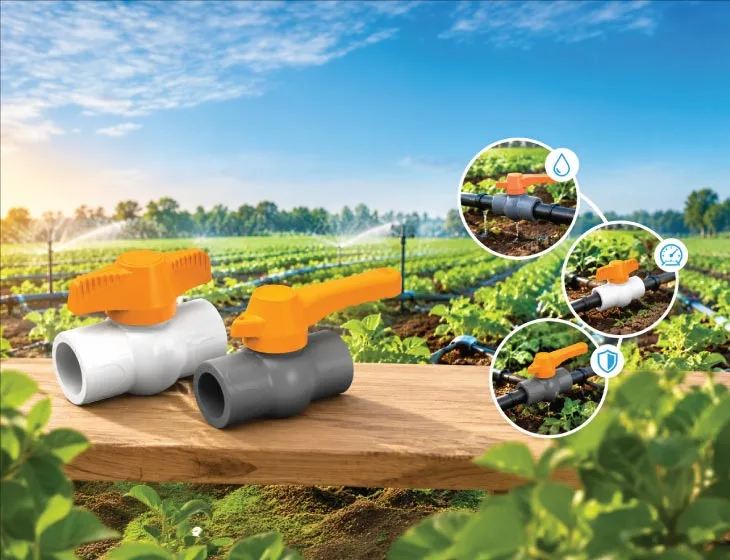
That is where a compact design can make a practical difference. A Compact Ball Valve has a space-saving design while still providing the basic function expected from a manually operated ball valve.
For agricultural applications, this can be useful when several control points have to be arranged within a relatively restricted area. The point is not that every irrigation system needs a compact valve. Rather, where space is limited, the dimensions of the valve become part of the decision.
Flow control does not always mean complicated control
There is sometimes a tendency to associate modern irrigation with increasingly complicated equipment. But not every part of an irrigation system needs to be complicated.
A manually operated ball valve can provide a straightforward way to control flow. The handle is turned when water needs to be allowed through or stopped, making the operation relatively simple for the person managing the system.
The PVC Compact Valves in the range are designed for irrigation head control units, where they can be used for flow regulation and shut-off in main irrigation assemblies.
That basic function can be useful on a farm because irrigation is often divided into sections. Being able to shut off one part of the arrangement without having to interfere with the rest of the system gives the operator a simple way to manage the water flow.
Where does a compact ball valve for drip irrigation fit?
Drip irrigation systems can involve multiple pipe sections and control points, particularly where different parts of the irrigation arrangement need to be managed separately.
A compact ball valve for drip irrigation can fit into such an arrangement when a manually operated shut-off or flow-control point is required and available space is limited.
The valve itself does not determine the entire irrigation design. Pipe sizes, connections and the overall layout still need to be considered. What the compact format does provide is another option when the valve has to fit neatly into the available space.
This becomes particularly relevant when valves are positioned close together or where there is not much room around an irrigation head control assembly.
The connection has to match the pipeline
A valve may have the right size and function, but it still needs to connect properly with the rest of the system.
The PVC Compact Valves are available in sizes ranging from ½ inch to 3 inches. Their connection options include threaded BSP, NPT and BSPT connections, as well as solvent-glued socket ends available in ISO, ASTM, BS and DIN standards.
That range gives installers different ways to approach the connection depending on the pipework being used.
This is also where irrigation pipeline fittings become relevant. A valve cannot be considered in isolation from the pipe and connection arrangement around it. The size and type of connection need to correspond with the rest of the installation so that the valve can be incorporated properly into the system.
What makes the PVC construction useful?
The material of a valve matters too. The PVC Compact Valves are manufactured using high-quality Poly Vinyl Chloride, with a design intended for agricultural, horticultural and industrial applications. The construction is described as durable and suitable for long-term performance.
For farming applications, this gives the valve a practical place in irrigation assemblies where a PVC valve is appropriate for the system.
A PVC compact valve for farming can therefore be considered when the application calls for a compact valve made from PVC and the available connections and pressure rating suit the installation.
The valves have a PN10 pressure rating and are intended for applications with temperatures up to 50°C. These specifications are useful when checking whether a particular valve matches the conditions of the planned installation.
A handle should not become a problem
A valve can have the right specifications on paper and still be frustrating if it is difficult to operate.
The compact PVC valves use a user-friendly design with smooth handle operation and low operational torque. That matters when a valve needs to be operated manually as part of routine irrigation management.
It is a small detail, but it matters when someone has to operate the valve as part of routine irrigation management. The person working with the irrigation system needs to be able to reach the valve and operate it without unnecessary effort.
In a field or agricultural setup with several valves, those practical details can affect how convenient the system is to manage.
Compact does not mean limited to one application
Although the focus here is irrigation, the valves are not restricted to one type of agricultural installation. The PVC Compact Valves are described for agricultural, horticultural and industrial applications. Within water-related systems, their stated applications include irrigation head control units and flow regulation and shut-off in main irrigation assemblies.
The PVC Compact Valves are available in several sizes, from ½ inch through 3 inches, which means the valve selection can be considered alongside the size and arrangement of the pipeline.
This is useful when a system has different sections with different connection requirements. The valve still needs to be selected according to the actual installation rather than simply because it belongs to a particular product category.
What about installation in smaller spaces?
A compact valve becomes most relevant when the available space is part of the installation problem.
A Compact Ball Valve can be easier to accommodate where pipework, control points and other components have to sit close together. This is particularly relevant in compact assemblies, where there may not be much room to work around each individual component.
That does not mean the valve can be placed anywhere. The surrounding pipework, connection type and accessibility still need to be considered.
Good compact valve installation is therefore less about simply choosing a smaller valve and more about making sure the valve fits properly into the planned arrangement and can still be reached when it needs to be operated.
What should you check before choosing one?
There are a few fairly straightforward things to look at before settling on a valve. First, check the pipe size and the required connection. The available PVC Compact Valve sizes run from ½ inch to 3 inches, while the threaded and solvent-glued options cover different connection standards.
Next, look at the pressure and temperature requirements. The valves have a PN10 pressure rating and are suitable for applications up to 50°C.
Then consider where the valve will actually sit. If the installation has limited room, the compact form may be particularly useful. If the valve is going to be operated manually, accessibility and handle movement also deserve attention.
Finally, think about what the valve needs to do. These valves are intended for flow regulation and shut-off in main irrigation assemblies, so the intended control point should be clear before installation.
How we approach valve selection at Automat ?
At Automat, we look at valves as part of the larger irrigation arrangement rather than as isolated components. Our PVC Compact Valves are designed for agricultural, horticultural and industrial applications, with different sizes and connection options to suit different installations.
The aim is not to suggest that a compact valve is the answer to every irrigation requirement. A valve needs to match the pipeline, pressure, connection and available installation space. When those requirements line up, however, a compact design can make the control point easier to accommodate.
The practical value of a smaller valve
Modern irrigation does not always mean adding more equipment. Sometimes it simply means making each part of the system fit the job a little better. A Compact Ball Valve can be useful when a control point has to fit into a smaller space.
A Compact Ball Valve can provide manual flow regulation and shut-off while offering a space-saving design. Its different sizes, connection options, PVC construction and low-torque handle operation are all worth considering when planning an irrigation assembly.
For farmers and irrigation installers, particularly when several control points need to fit into a restricted area, that can be a useful combination.
In the end, good irrigation control comes down to being able to manage water where and when it is needed. The valve is only one part of that process, but choosing one that fits the pipeline, operating conditions and available space can make the overall arrangement more practical.
At Automat, we see that as the real purpose of a compact valve: not simply being smaller, but fitting into the irrigation system in a way that makes everyday flow control straightforward.
FAQs
Can I control water pressure with a Compact ball valve?
The valve is designed for flow regulation and shut-off, but the supplied specifications do not state that it is intended specifically for pressure control.
Where are compact ball valves used in irrigation?
They can be used in irrigation head control units and main irrigation assemblies for flow regulation and shut-off.
Can compact ball valves be used in drip irrigation systems?
Yes they can be used in drip irrigation if a manual flow control or shut-off point is needed and space is limited.
What material is best for a compact ball valve?
The PVC Compact Valves are made from high-quality PVC and are designed for agricultural, horticultural and industrial applications.
How do compact ball valves help control irrigation water flow?
They give the operator a simple way to regulate or shut off water flow to particular sections of an irrigation system.

Download Mobile App


Get in touch

Plot no. 18-19, Dilshad Garden, G.T. Road, New Delhi 110095.


