
Popular Searches
Popular Searches

Matching Rain Guns to Maize and Sugarcane Fields with Large Coverage Needs
Large fields change the way irrigation behaves. What feels manageable in a few acres becomes harder to control as rows stretch longer and spacing opens up.
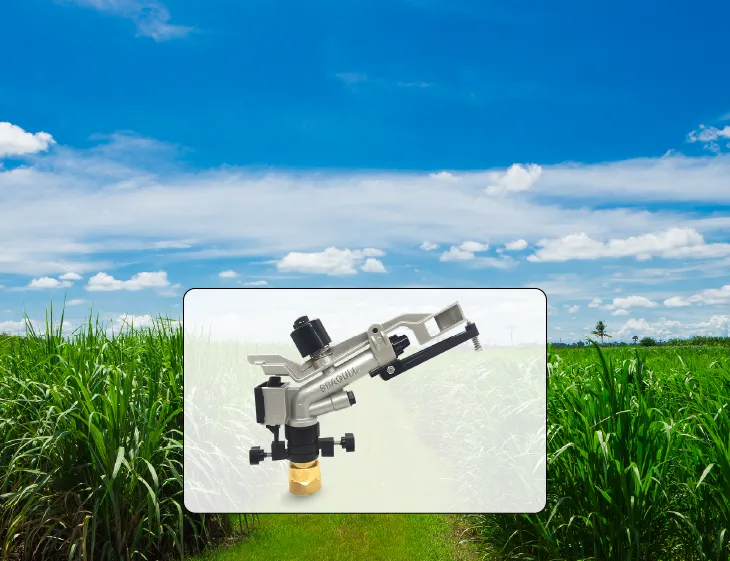
Large fields change the way irrigation behaves. What feels manageable in a few acres becomes harder to control as rows stretch longer and spacing opens up. In maize and sugarcane fields especially, the distance water needs to travel starts influencing every decision. At that scale, irrigation stops being about fine control and starts becoming about reach, stability, and how reliably water lands where it is expected to.
Rain guns are often brought into these situations not because they are advanced, but because they are practical. They solve a coverage problem first. Everything else comes later.
Why maize and sugarcane fields behave differently ?
Maize and sugarcane share one important trait. They are grown in open layouts where uniform watering matters more than pinpoint delivery. These crops develop deeper root systems and respond better when moisture is spread evenly across the soil surface rather than concentrated in one place.
As the canopy grows, especially in sugarcane, irrigation needs to push through foliage and still reach the ground. Short-range sprinklers struggle here. Overlapping sprays become inefficient, and pressure loss shows up quickly. This is where irrigation for tall crops starts demanding longer throw and steadier rotation rather than tighter spacing.
Coverage matters more than density
In wide fields, installing many closely spaced sprinklers increases pipe length and raises pressure loss along the line. It also adds more joints and fittings that need monitoring. Rain guns reduce this density by covering large sections from a single point.
This is where a rain gun sprinkler system begins to make sense. Fewer risers and fewer connections mean fewer places for pressure imbalance to creep in. For maize and sugarcane, this simplicity helps keep irrigation predictable across long runs. In many cases, this is where farmers begin evaluating the best rain gun for farming instead of adding more equipment.
How rain guns handle open field conditions ?
Rain guns are built to stay outside and keep working. They operate through wind, dust, and long irrigation hours. Aluminium die-cast bodies, brass components, and stainless steel hardware are not extras. They are required for equipment that remains exposed through entire seasons.
Most models include a jet breaker screw that allows spray adjustment without changing installation. Heavier droplets travel farther in calm weather. When wind picks up, the spray can be softened slightly to reduce drift. This kind of adjustment becomes important in large fields where conditions vary across the day.
Matching range to field scale
In practical terms, the best rain gun sprinkler is the one that fits the field, water supply, and daily conditions without needing constant correction. Smaller units work where spacing is moderate and pressure availability is limited. As field width increases, larger models become more effective because they maintain reach without heavy overlap.
For many farmers, this decision is closely linked to the maize irrigation method being followed. A rain gun that throws farther than needed often wastes water at the edges. One that falls short forces tighter spacing and defeats the purpose. Matching throw radius to actual field dimensions usually gives more consistent results and avoids overworking the system.
Pressure behavior across long pipelines
Pressure rarely stays constant in large irrigation layouts. As distance increases, pressure drops naturally. Rain guns are designed to operate within defined pressure ranges so small variations do not affect rotation or spray pattern.
When run within these limits, movement stays steady and distribution remains predictable. This reliability becomes especially important in sugarcane sprinkler irrigation, where long pipelines and dense foliage can expose even minor pressure changes. This is another point where farmers reassess what truly qualifies as the best rain gun for farming in their conditions.
Manual movement and seasonal flexibility
Maize and sugarcane fields rarely stay laid out the same way year after year. Row spacing changes, plant counts go up or down, and sometimes a different crop takes the place of the old one. Rain guns work well in this kind of setup because they are easy to shift when the field changes.
Set on simple risers or stands, they can be moved across the field without pulling apart pipes or starting over. That flexibility allows irrigation to adapt along with the crop instead of locking farmers into fixed layouts every season.
Maintenance in everyday field use
Rain guns do need looking after, but it’s usually straightforward work. Most days it comes down to checking the nozzle, clearing surface dirt, and making sure the jet breaker hasn’t stuck. Since everything is out in the open, these checks are quick and rarely delay irrigation.
In busy seasons, this matters. Equipment that demands constant attention tends to be ignored. Rain guns that run steadily in the background are more likely to stay in service over the long term.
Choosing based on water availability
Water availability plays a larger role than many expect. Rain guns operate at higher discharge rates, so the source must support that demand. In areas with limited supply, spacing and run time need careful planning.
When matched correctly, rain guns still perform efficiently. They reduce overlap losses and help water soak evenly into the soil. Farmers soon realise that the best rain gun for farming depends as much on water reliability as on field size or crop type.
Long term performance in large crop fields
In large fields, irrigation equipment is judged over years, not weeks. A rain gun that maintains throw radius, rotates smoothly, and handles pressure variation without fuss earns trust.
Farmers often describe such equipment simply as the best quality rain gun, not because of specifications, but because it keeps performing season after season.
Also Read: What is a Rain Gun Irrigation System and How Does It Work?
Conclusion
Maize and sugarcane fields demand irrigation systems that can cover distance without losing control. Rain guns meet this need by delivering wide coverage, stable rotation, and flexibility across large layouts.
When matched carefully to field size, pressure availability, and crop requirements, rain guns become a dependable part of seasonal irrigation rather than a constant concern. This grounded, field-driven way of thinking reflects how Automat Global approaches irrigation design, keeping systems working reliably at scale. Over time, that consistency is what defines the best rain gun for farming.
FAQs
How much area does one rain gun cover?
Coverage depends on the model and pressure, but most rain guns are used to cover large open areas by throwing water anywhere from around 18 metres to over 40 metres in radius when set correctly.
Are rain guns suitable for sugarcane?
Yes, rain guns are commonly used in sugarcane because they can push water through tall canopy growth and spread moisture evenly across wide fields.
What pressure is needed for rain guns?
Rain guns typically operate within a defined pressure range, and most field models are designed to work steadily once the system maintains that recommended pressure without sharp fluctuations.
Do rain guns save labour?
They often do, since fewer sprinklers are needed to cover the same area, which reduces the time spent shifting equipment and monitoring multiple points.
Can rain guns be used for maize crops?
Yes, maize fields are well suited to rain guns because uniform, wide-area watering matches the crop’s spacing and growth pattern in open layouts.

Download Mobile App


Get in touch

Plot no. 18-19, Dilshad Garden, G.T. Road, New Delhi 110095.


