
Popular Searches
Popular Searches

How Do Self-Cleaning Filters Reduce Irrigation System Maintenance?
Self-cleaning filters do not make an irrigation system maintenance-free. What they can do is change how routine filter maintenance is handled.
Self-cleaning filters do not make an irrigation system maintenance-free. What they can do is change how routine filter maintenance is handled.
Conventional filters collect the material they remove from irrigation water, which means they need to be cleaned regularly. As debris builds up, someone eventually has to clear it out. A self-cleaning filter handles this differently. It runs a cleaning cycle on its own, so the filter doesn't need to be cleaned by hand as often.
This can make a noticeable difference when a filtration system needs frequent cleaning. There is simply less routine work involved in keeping the filter clear.
The part of filtration that usually takes time
Water from reservoirs, rivers and other surface sources can carry algae and organic matter. A filter catches these impurities before the water moves further into the irrigation system. But whatever the filter catches has to go somewhere. It builds up on the discs, and eventually those discs need cleaning. For a system that is cleaned manually, this becomes one more job to keep track of. And when filtration is protecting drip irrigation emitters from clogging, leaving that job for too long isn't particularly helpful. This is where an automated cleaning cycle changes things. An Automatic Disc Filter for Irrigation can handle the cleaning process without making manual disc cleaning part of the regular routine.
Cleaning without taking the filter apart
An Automatic Disc Filter for Irrigation can handle the cleaning process as part of its normal operation. With the AquaDisc Fully Automatic Disc Filter, the cleaning cycle can be triggered by pressure differential, time or a manual command. During the cycle, the discs are back flushed and the accumulated material is removed. The operator doesn't have to make manual disc cleaning the routine way of dealing with buildup. That doesn't mean the filter can be forgotten. It simply moves the cleaning process into the operation of the filtration system itself.
What happens during back flushing?
Back flushing is essentially the cleaning stage of the process. Water is used to remove the material that has collected during filtration. AquaDisc is designed to carry this out with less water and in less time during the cleaning cycle. The AquaDisc HF models use a Spray-Jet mechanism for back flushing at lower pressures. For someone looking after an irrigation system, this can remove one of those repetitive maintenance tasks that otherwise needs to be done by hand. An Automatic Disc Filter for Irrigation also brings the cleaning cycle into the normal operation of the filter, rather than leaving all of the cleaning work to the operator.
Why does this matter for drip irrigation?
A drip irrigation filtration system has an important job. The water reaching the emitters needs to be filtered well enough to protect them from clogging. This matters when the irrigation water comes from a surface source containing algae or organic matter. The AquaDisc range is designed for such water and is intended to prevent emitter clogging. There is also a practical side to it. If a filter needs regular manual cleaning, somebody has to notice when it needs attention and then carry out the cleaning. An automatic cycle takes care of that particular part of the routine. It doesn't change what the filter is filtering. It changes how the collected material is dealt with.
For anyone looking for a filter for micro irrigation, the same basic consideration applies: the filtration equipment needs to suit the water source and the requirements of the irrigation system.
When does the filter decide to clean?
The cleaning cycle doesn't have to depend on someone noticing that the filter needs attention. For the AquaDisc Fully Automatic Disc Filter, cleaning can be initiated by pressure differential, time or a manual trigger. This gives the system more than one way to start the cycle. Once the back flushing is finished, filtration resumes. That is a fairly straightforward change, but it can matter in systems where the filter is working regularly. Instead of treating cleaning as a separate maintenance activity every time, it becomes part of the filter's normal operation.
What kind of water can it handle?
The agricultural applications listed for AquaDisc include surface water containing algae and organic matter from reservoirs, rivers and waste treatment plants. The filters can also be used for landscaping and turf irrigation in places such as institutional parks, residential complexes, sports fields and golf courses. The water source is still something to consider before selecting any filtration equipment. An automatic cleaning function doesn't make a filter suitable for every type of water.
The discs aren't the only thing to look at
There is more to the AquaDisc design than its cleaning cycle. The filters are made from high-grade anti-corrosion polymeric material and have a high filtration area. They use modular manifolds, which allow the system to be installed and expanded according to the requirements of the setup. Their compact footprint also makes them easier to accommodate where installation space is limited. These features do not replace the need for proper filtration selection. They are simply other parts of the equipment that need to be considered alongside the cleaning arrangement.
Does automatic cleaning remove maintenance completely?
No. A self-cleaning filter still needs to be checked and operated as part of the irrigation system. Automatic cleaning reduces the need for someone to carry out routine disc cleaning manually, but it doesn't mean the equipment can be ignored. This distinction is easy to miss when the term “self-cleaning” is used. The filter cleans itself, but the irrigation system still needs attention.
For systems where regular filter cleaning takes up considerable time, irrigation water filtration equipment with an automatic cleaning function can make that routine less hands-on.
Choosing the right size
The filter also needs to suit the irrigation system itself. The AquaDisc Fully Automatic Disc Filter is available in 3, 4, 6 and 8-inch sizes. The AquaDisc HF range comes in 6, 8, 10 and 12-inch sizes. The water being filtered is another consideration, particularly when surface water contains algae and organic matter. Then there is the cleaning arrangement. Automatic cleaning can be triggered by pressure differential or time, while a manual trigger is also available when required. Looking at these details together is more useful than focusing on the self-cleaning feature alone.
What should you consider during installation?
The available space should be considered during disc filter installation, particularly when the filtration setup needs room for its connections. The AquaDisc filters use modular manifolds, which allow the system to be installed and expanded according to the requirements of the setup. Their compact footprint can also be useful where installation space is limited. The installation itself is therefore another part of planning the filtration setup, rather than something to think about only after the equipment has been selected.
Where AquaDisc fits in
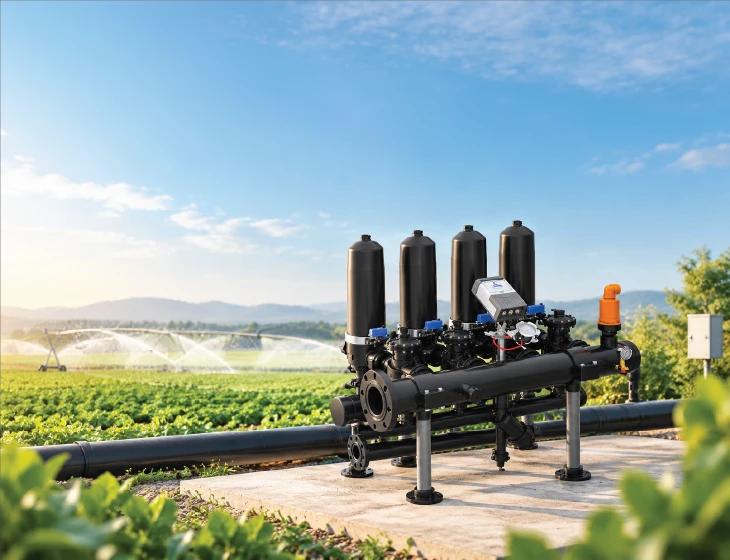
At Automat, we offer the AquaDisc Fully Automatic Disc Filter with automated cleaning as part of the filtration process. Its FILTER SMART controller manages operation, while the back flushing cycle is designed to use less water and time. The AquaDisc HF models use the Spray-Jet cleaning mechanism and are designed for high-flow applications. Both ranges use polymeric construction and are intended to protect irrigation systems from impurities and prevent emitter clogging.
At Automat, the automatic disc filter approach can be useful when regular manual cleaning has become a recurring part of maintaining the irrigation system.
Conclusion
There is nothing complicated about why self-cleaning filters can reduce maintenance. A filter collects the material it removes from water, and that material eventually has to be cleaned away. With an Automatic Disc Filter for Irrigation, that cleaning can happen through a back flushing cycle rather than requiring someone to manually clean the discs each time. The cycle can be triggered by pressure differential, time or a manual command, depending on the setup.
That doesn't make the irrigation system maintenance-free. It simply makes one recurring job less dependent on manual effort. For systems dealing with surface water and regular filtration requirements, a self-cleaning disc filter irrigation setup can be a practical way to reduce the amount of routine cleaning that has to be done by hand.
FAQs
What is an automatic cleaning irrigation filter?
It is a filter that cleans the material it collects from irrigation water without needing someone to do the cleaning by hand each time.
How does an automatic disc filter clean itself?
It back flushes the discs to clear the collected material. The cycle can start based on pressure difference, time or a manual trigger.
Why is filtration important in irrigation systems?
It helps keep unwanted material out of the irrigation system, and helps protect things like drip emitters from clogging.
Can automatic disc filters be used for drip irrigation?
Yes. AquaDisc filters are designed to protect drip irrigation systems and to help prevent clogging of emitters.
How do I choose the right automatic disc filter for irrigation?
Begin with the water source and size of your irrigation system, then look at the size of the filters available and the cleaning options.

Download Mobile App


Get in touch

Plot no. 18-19, Dilshad Garden, G.T. Road, New Delhi 110095.


