
Popular Searches
Popular Searches

How Sand Media Filters Keep Your Drip System Running (And Your Crops Actually Growing)
If you've ever walked your field in the morning and noticed some plants looking stressed while others right next to them are perfectly fine - there's a good chance your drip emitters are clogged.
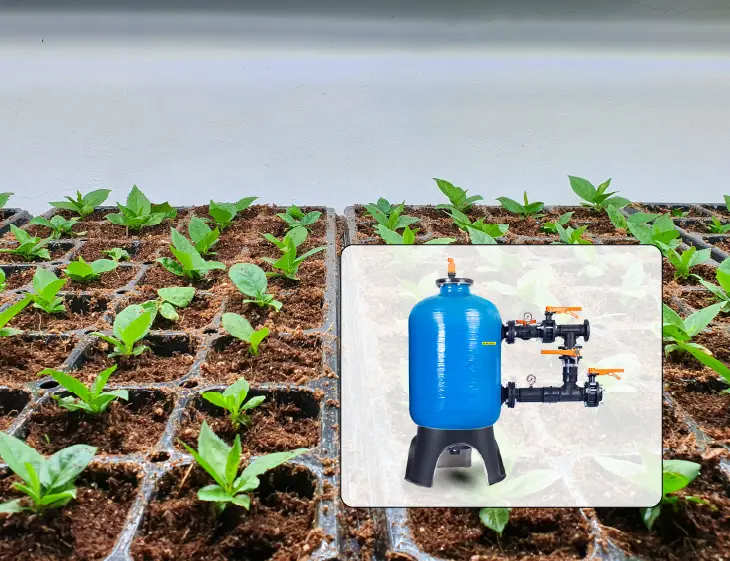
If you've ever walked your field in the morning and noticed some plants looking stressed while others right next to them are perfectly fine - there's a good chance your drip emitters are clogged.
It's one of those problems that sneaks up on you. The system looks like it's running. The pump is on. Water is flowing. But somewhere down the line, tiny particles have quietly blocked the emitters, and your crops are paying for it.
We've seen this happen with canal water, pond water, even borewell water that looks clean but carries enough silt and organic matter to cause real damage over a season. The fix isn't complicated - but it does require the right filtration upfront.
That's where a sand media filter comes in.
So What Even Is a Sand Media Filter?
Think of it as a bouncer for your irrigation system. Water comes in dirty carrying sand, algae, rust flakes, organic bits - and only clean water gets through to your pipes and emitters.
Inside the filter tank, there are layers of specially graded sand and gravel. As water pushes through these layers, the particles get trapped. Clean water exits the other side and moves into your drip lines. Simple in concept, but genuinely effective in practice.
These filters are used across all kinds of setups like drip systems, sprinkler systems, fertigation units and greenhouses. Basically, anywhere that water quality matters, which is everywhere.
Why Drip Systems Clog (And Why It's a Bigger Problem Than You Think)
Drip irrigation system works because the emitter openings are tiny - that's the whole point. Water drips slowly, right at the root zone, nothing wasted. But those same small openings are exactly what makes them vulnerable.
Sand, silt, algae, mineral build-up, even bacterial slime - any of these can partially or fully block an emitter. And once a few go down, the pressure in that line shifts. Some plants get flooded, others get almost nothing. You end up with an uneven crop that's harder to manage and lower-yielding at harvest.
Replacing emitters costs money. Cleaning blocked pipelines takes time. And in the meantime, your crops are suffering through inconsistent watering that no amount of fertilizer can fully compensate for.
What a Sand Media Filter Actually Does for Your System ?
The most obvious job is keeping particles out of your drip lines. But the benefits go further than that.
When water is consistently clean, your emitters last longer. Your valves don't wear out as fast. The pressure across your field stays stable, which means every plant in the row gets roughly the same amount of water - not just the ones near the main line.
If you're running fertigation (mixing fertilizers into your irrigation water), clean water matters even more. Nutrient solutions move through the system without blockage, which means your crops actually receive the feed you're paying for - not just the plants closest to the injection point.
Over a full growing season, that consistency shows up in your yield. Not dramatically on day one, but cumulatively - healthier root development, more even growth, fewer stress-related losses.
How the Backwash SELF CLEANING System Works ?
One thing that puts people off sand media filters is thinking they need constant maintenance. Modern units handle most of that automatically.
When the filter gets loaded with trapped particles, a backwash/ self cleaning cycle kicks in - either on a timer or triggered by pressure differential. Water flows backward through the media, out through a backflush valve, flushing out the collected debris, and the filter resets itself. In most field setups, you're just checking it periodically rather than cleaning it by hand every few days.
For high-contamination sources like open canals or ponds, you might run multiple filter units in series. For cleaner borewell water, a single unit usually does the job.
Picking the Right One for Your Setup
A few things worth thinking about before you buy:
Your water source matters most. Canal and pond water carry a lot more organic load than borewell water, so you'll need higher capacity. Get your water tested if you're unsure — it saves guesswork.
Match the filter's flow rate to your system. A filter that's undersized for your pump output won't keep up, and filtration quality drops.
Look for automatic backwash or self-cleaning systems if you're covering a large area. Manual cleaning works for smaller farms, but for anything above 3–5 hectares, automation saves labour, reduces downtime, and keeps filtration efficiency consistent.
Also pay attention to the internal underdrain design. A good sand media filter should distribute water evenly during filtration and cleaning, helping prevent media channelling and improving dirt removal efficiency.
And don't cheap out on the tank material. A steel tank without proper corrosion protection will not last long, especially with fertilizer-rich water. Reinforced polymer or FRP-based filters are lighter, rust-free, UV resistant, and designed for long outdoor agricultural use.
The Bottom Line
A sand media filter isn't the flashiest part of your irrigation setup - but it's often the reason everything else works properly.
Clean water keeps your emitters clear, your pressure stable, and your crops watered evenly. That consistency, season after season, is what actually moves the needle on yield.
If you're already running drip irrigation and haven't put a proper filter in place, it's worth doing before your next season. The cost is modest. The difference it makes to your system's reliability — and your crop performance — is real.
FAQs
Does it actually improve yield?
Yes - but not magically. It improves the consistency of irrigation, which reduces stress on crops and supports more even growth. That shows up in yield over time.
How often does it need cleaning?
With an automatic backwash system, not very often on your end. Manual systems depend on your water quality - high-sediment sources may need attention weekly during peak season.
Which crops benefit most?
Any plant can benefit from an irrigation system, but the difference is especially noticeable in vegetables, fruit orchards, and greenhouse crops where emitter precision matters most.
Can I use it with fertigation?
Yes, Mach Clean’s corrosion-resistant reinforced polymer body handles fertilizer-rich water efficiently, preventing clogging and ensuring uniform nutrient distribution.

Download Mobile App


Get in touch

Plot no. 18-19, Dilshad Garden, G.T. Road, New Delhi 110095.


