
Popular Searches
Popular Searches

Why Sand Media Filters Are Essential for Clean Water in Groundnut Irrigation ?
In many groundnut farms, irrigation water comes straight from a borewell, pond, or canal. It may look clear when it fills the pipeline, but once the system starts running, small particles begin traveling with it.
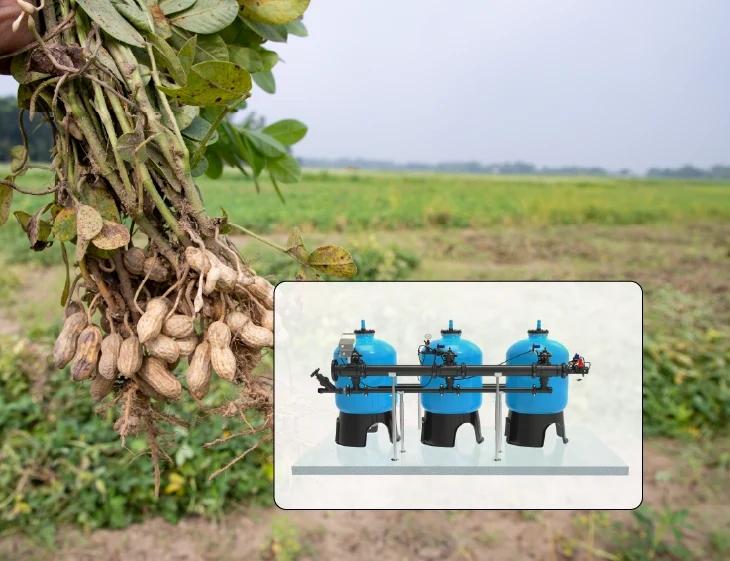
In many groundnut farms, irrigation water comes straight from a borewell, pond, or canal. It may look clear when it fills the pipeline, but once the system starts running, small particles begin traveling with it. Over time, those particles settle inside emitters and valves, slowly affecting how evenly water reaches the crop.
Groundnut fields need fairly even watering around the root zone. When the flow slows down in certain parts of the system, the plants usually don’t react immediately. But after a while you can see the difference across the field. Many times this starts with tiny impurities travelling through the irrigation pipes.
That is why filtration plays such a central role in modern irrigation setups.
Groundnut irrigation and water quality
Groundnut irrigation often depends on drip or micro-irrigation systems because they deliver water directly where it is needed. This improves efficiency and helps farmers manage limited water supplies.
However, these systems also contain narrow passages and emitters that are sensitive to impurities. When sand, organic matter, or suspended particles enter the system, they gradually build up in these small openings. The result is uneven discharge across the field.
Even when pumps and pipelines are working perfectly, unfiltered water can quietly disrupt irrigation performance. For this reason, many farms rely on a sand media filter for Groundnut Irrigation to remove these impurities before water enters the distribution network.
Groundnut drip irrigation and emitter protection
Groundnut drip irrigation works best when water remains clean throughout the system. The emitters that release water near the crop roots are designed for controlled flow. When particles enter the line, they can partially block these outlets.
A partially clogged emitter may still release water, but the discharge rate becomes irregular. Some plants receive adequate moisture while others get less.
Primary filtration becomes important for this reason. A sand media filter for Groundnut Irrigation catches much of the silt, organic matter, and fine particles before the water moves further into the system. When these impurities are removed early, the pipes and emitters tend to keep working the way they should, and water spreads more evenly across the field.
The role of an irrigation filtration system
Many irrigation setups use more than one level of filtration. The first one usually handles the heavier particles that come in with the water. If the supply is coming from a pond, canal, or open well, it often carries silt, clay, or bits of organic matter along with it.
That’s where a sand media filter for Groundnut Irrigation is usually placed. Water passes through the sand inside the filter, and most of those particles get held back there. The water that moves forward into the irrigation lines is much cleaner, which helps the system keep running without frequent clogging.
Sand media filter for irrigation systems
A sand media filter for irrigation systems is designed specifically for conditions where water carries organic or suspended material. These filters are commonly installed at the beginning of the irrigation line so they can capture impurities before the water moves into pumps and pipelines.
The Machclean Sand Media Filter Automat manufacture is designed to serve as primary filtration for drip and micro irrigation systems, particularly useful when water comes from op en sources such as lakes, rivers, ponds, or wells.
The filter body is made with reinforced glass fibre, so it handles moisture, chemicals, and regular field use without much trouble. As water moves through it, sand and other particles get trapped before they can enter the irrigation lines.
Cleaning it usually doesn’t take much effort. It can be used in manual mode or set to run automatically, depending on the system.
Are sand filters better for surface water
A common question farmers ask is simple: are sand filters better for irrigation systems that rely on natural water sources?
Water drawn from surface sources tends to contain organic material along with fine particles. Sand media filters perform well under these conditions because they capture both biological contaminants and suspended solids.
The Machclean Automatic Sand Media Filter is designed to handle these situations. Its anti-clogging flute design helps reduce pressure drop while maintaining efficient filtration, which helps the irrigation systems to run longer without interruption.
Farming filtration equipment in everyday use
Farming filtration equipment has to keep working through long irrigation hours and changing weather. Filters sit outdoors, dealing with moisture, fertilizer, heat, and humidity through the season.
The Machclean filter uses reinforced glass fibre for strength, with polypropylene parts inside that handle regular use well. Since it’s lighter than metal filters, most farmers find it easier to install, clean, and manage during routine maintenance.
Why filtration matters throughout the season ?
Groundnut crops grow close to the soil surface, but the pods develop underground. This makes uniform irrigation particularly important during the growing period.
When irrigation systems deliver water unevenly due to clogging or flow disruption, the effect may not be visible immediately. Over time, uneven moisture levels influence plant growth and pod formation.
Using a sand media filter for Groundnut Irrigation helps prevent many of these problems before they appear. By filtering out sand, organic particles, and suspended solids, the irrigation system continues operating with fewer interruptions.
When the water is cleaner, valves, pipes, and emitters simply last longer because they’re not constantly dealing with sand and debris.
A practical approach to filtration
At Automat, we look at irrigation systems as complete working setups rather than isolated components. Pumps, pipes, valves, and emitters all depend on water quality to perform consistently.
Our Machclean sand media filters are designed to support primary filtration for drip and micro-irrigation systems. So the thinking is quite practical. Stop the sand and organic particles at the start, and the rest of the irrigation setup is far less likely to give problems later.
This approach helps reduce maintenance demands and protects the long-term performance of the entire system.
Conclusion
Clean irrigation water plays a larger role in groundnut farming than it may appear at first. Sand, silt, and organic particles carried by irrigation sources can gradually affect the performance of drip systems.
Installing a sand media filter for Groundnut Irrigation helps remove these impurities before they enter pipelines and emitters. This keeps water distribution more uniform across the field and protects the irrigation network from clogging.
When filtration is handled properly at the beginning of the system, the rest of the irrigation setup tends to run more reliably throughout the season.
FAQs
Why is filtration important in groundnut irrigation?
Groundnut systems, especially drip setups, have small passages that clog easily. Filtration helps keep water clean so it spreads evenly across the field.
Why sand filters for groundnut?
Sand filters handle silt, organic matter, and fine particles well, which are common in pond or canal water used for irrigation.
Do sand filters clean groundnut water?
They remove much of the sand, silt, and organic debris before the water reaches pipes and emitters.
Sand filters prevent clogging groundnut?
They help reduce clogging by catching particles early, before they settle inside emitters and valves.
How sand filters help groundnut?
Cleaner water means more uniform irrigation, which helps the crop receive consistent moisture across the field.
Can sand media filters improve irrigation efficiency?
Yes. If the pipes and emitters stay clear, irrigation simply runs better and the water spreads more evenly across the field.

Download Mobile App


Get in touch

Plot no. 18-19, Dilshad Garden, G.T. Road, New Delhi 110095.


