
Popular Searches
Popular Searches

Types of Water Meters Explained: A Complete Guide Across Industries
Buying a water meter sounds like a simple job until you start looking at the options. One supplier talks about Woltman meters, another recommends ultrasonic models, and then someone brings up AMR and AMI.
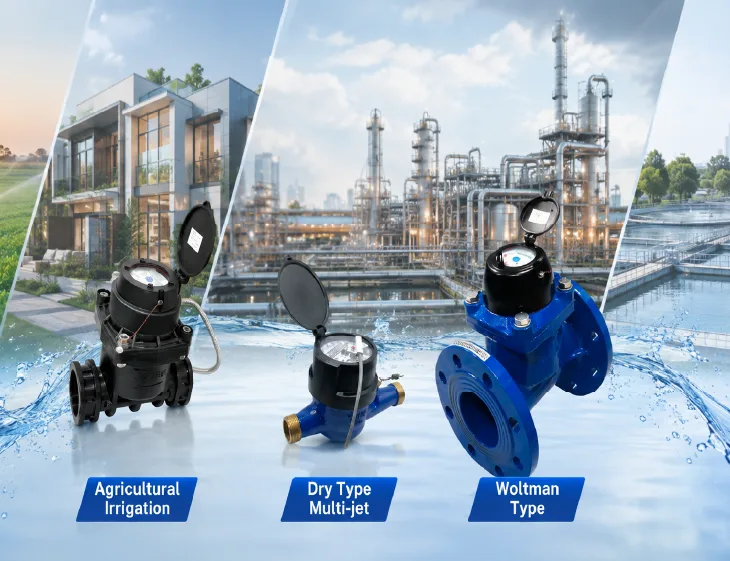
Buying a water meter sounds like a simple job until you start looking at the options. One supplier talks about Woltman meters, another recommends ultrasonic models, and then someone brings up AMR and AMI. Before long, it feels like you're comparing a completely different set of products.
The fact is that each water meter is designed to solve a different problem, some are better at measuring very low flows, while others are designed to cope with thousands of liters moving through large pipelines. Knowing what each meter is supposed to do makes it much easier to choose the correct meter.
1. Mechanical Water Meters
Mechanical water meters are still widely used in homes and small commercial spaces. Inside the meter, a small mechanism turns as water passes through it, and that movement is used to measure the flow. Single-jet and multi-jet water meters are the two common versions.
They're relatively affordable, don't take much effort to service and have proven reliable for everyday use. That's why you'll still find them in houses, apartment buildings and small shops.
Best for: Homes, apartments, small shops and low-pressure connections.
2. Positive Displacement (PD) Meters
When the water is moving slowly, being able to measure every little amount accurately is more important. That is where Positive Displacement (PD) meters come in handy. They have a chamber that fills up and empties as the water flows through it with the meter recording these fixed quantities. This type of measurement is commonly used for residential billing and smaller commercial units.
Best for: Residential billing, small commercial units and low-flow applications.
3. Woltman (Turbine) Meters
Once water volumes get much higher, a different kind of meter is needed. For these larger flows, Woltman meters are designed and use a turbine style rotor to measure the water passing through the pipeline .
The design allows large quantities of water to move through the meter with minimal pressure loss. You'll therefore find Woltman meters on bulk supply lines, municipal distribution systems and large industrial intake points.
Ideal for: Bulk supply lines, municipal distribution and large industrial intake points.
4. Electromagnetic Flow Meters
Electromagnetic flow meters use magnetic fields to measure the water passing through them. There is no mechanical rotor inside, so there is very little to wear out during normal operation. They can also be used with dirty or chemically treated water, making them a useful option for several industrial applications.
Best for: Textile and dyeing units, wastewater treatment, pharmaceutical manufacturing and food processing.
5. Ultrasonic Water Meters
With an ultrasonic water meter, there are no moving parts doing the actual measuring. It uses sound waves to determine how fast water is travelling through the pipe, which also means there is very little mechanical wear as the meter operates. Less wear generally means less maintenance over time.
The accuracy of ultrasonic meters is another reason they are being used for smart metering projects and wherever precise flow readings are important.
Best for: Smart city projects, high-precision industrial applications and retrofit installations.
6. Smart Water Meters (AMR & AMI)
With smart water meters, the interesting part isn't only how the water is measured. It's what happens to the reading afterwards.
AMR, or Automatic Meter Reading, sends the meter reading automatically to a central system. AMI, or Advanced Metering Infrastructure, allows communication in both directions. AMI gives utilities a much clearer view of water use as it happens. It can also help spot unusual usage, and help identify leaks without someone having to check the meter in person.
Best for: Municipal utilities, Jal Jeevan Mission and AMRUT 2.0 projects, housing societies and large industrial campuses.
7. Bulk Water Meters
Bulk water meters are used when you are moving a lot more water than you would in a house or small building. They are used on pipelines carrying water between treatment plants, reservoirs and distribution networks, where measuring large volumes is part of the job. That makes them more suited to large-scale water transfer than everyday household connections.
Best for: Water utilities, irrigation authorities and large agricultural estates.
Matching Meter Type to Industry
| Industry | Recommended Meter Type |
|---|---|
| Residential/Apartments | Multi-jet or PD meter |
| Textile & Dyeing | Electromagnetic flow meter |
| Agriculture/Irrigation | Bulk or Woltman meter |
| Municipal Utilities | Smart AMI meter |
| Pharma/Food Processing | Electromagnetic or ultrasonic |
The Bottom Line
The "best" water meter isn't the same for everyone. A meter that's ideal for a home may not be suitable for a factory, and one that's designed for a municipal pipeline would be unnecessary for a small commercial building.The better approach is to start with your application. Think about how much water is flowing, the quality of the water and the kind of information you want from the meter. Once those questions are answered, choosing the right type becomes much easier. A good match can also reduce maintenance, improve billing accuracy and make it easier to move to smarter water management in the future.
FAQs
What is the most accurate type of water meter?
The most accurate meters are generally thought to be ultrasonic and electromagnetic because they do not have moving parts that wear out over time with use. That depends on the application, but electromagnetic flow meters are widely used in industry because they can handle high flow rates and work well with treated or chemically active water.
Which water meter is best for industrial use?
It depends upon the application, but electromagnetic flow meters are widely used in industry because they can handle high flow rates and work well with treated or chemically active water.
What's the difference between AMR and AMI water meters?
AMR automatically sends meter readings to a central system. AMI does that as well, but it also allows two-way communication for functions such as real-time monitoring, leak detection and remote configuration.
Are smart water meters worth it for housing societies?
They can be for many housing societies. They make meter readings easier, help identify leaks sooner and give residents a clearer picture of how much water they’re using.
What type of meter is used for irrigation?
Bulk water meters and Woltman (turbine) meters are typically used for irrigation as they are constructed to pass large volumes of water with minimal pressure loss.
Download Mobile App


Get in touch

Plot no. 18-19, Dilshad Garden, G.T. Road, New Delhi 110095.


