
Popular Searches
Popular Searches

How to Choose the Right Water Meter for Residential, Industrial & Agricultural Applications ?
Most people don't pay much attention to how water is measured. That usually changes when the water bill looks wrong, a leak is suspected, or someone asks how much water has actually been used.
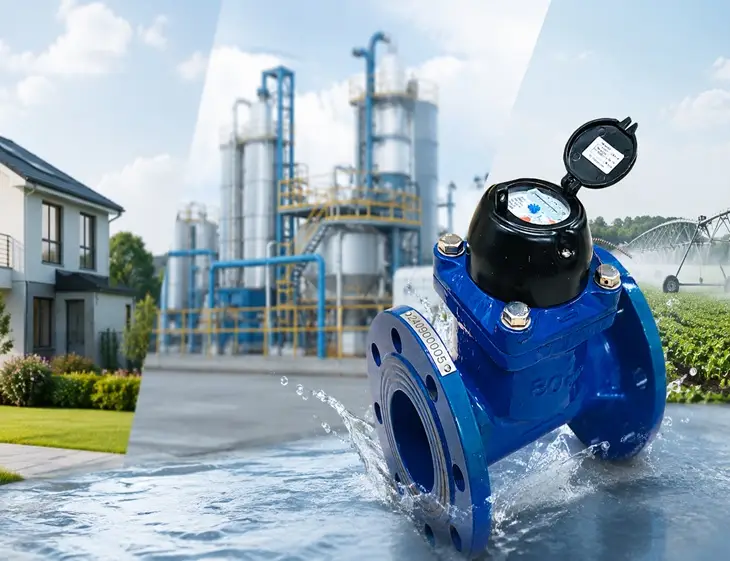
Most people don't pay much attention to how water is measured. That usually changes when the water bill looks wrong, a leak is suspected, or someone asks how much water has actually been used.
A water meter gives you that information. It records the water moving through a pipe and turns it into something that can be monitored. The tricky part is choosing the right meter in the first place. A meter that works perfectly well in a house may not be suitable for an irrigation system or a manufacturing plant.
The type of application, the amount of water involved and the conditions around the installation all need to be considered.
What do you need the meter to measure?
It is worth answering a few basic questions before looking at specific meters.
How much water is expected to pass through it? Will the flow stay fairly steady or change throughout the day? And what will the readings actually be used for?
These details make a difference. A household meter may be dealing with a tap, toilet or small leak, while an irrigation line can carry hundreds of gallons per minute. Using the same type of meter for both situations would not make much sense.
For homes, low flow matters
A lot of household water use happens at relatively low flow rates. A tap may only be running for a few minutes, a toilet may be filling, or there may be a slow leak somewhere in the plumbing.
Positive displacement meters are useful in these conditions because they measure fixed volumes of water as it passes through the meter. This makes them well suited to low and intermittent flow.
Smart meters are becoming more common as well. In addition to measuring water volume, some can transmit data wirelessly and provide features such as leak alerts, remote billing and consumption tracking through an app.
For a homeowner, being able to spot unusual water use can be useful, particularly when a higher-than-expected bill has no obvious explanation.
For residential use, look at low-flow accuracy, size, installation and smart connectivity.
Industrial sites have different demands
Water use in an industrial facility can be on a completely different scale. Cooling systems, boiler feed lines, waste water treatment and manufacturing processes can all require substantial volumes of water.
The water itself can be an issue as well. It can have particulates or chemicals in it, and some applications have large temperature changes. At the same time, shutting down equipment for maintenance may not be practical.
Turbine meters are commonly used where flow is high and relatively steady. Alternatively, an electromagnetic meter is particularly useful if the water is dirty or abrasive. There are no moving parts and therefore fewer mechanical components that are subject to wear from grit and debris.
They can also measure accurately across a wide range of flow rates, which is useful when water demand changes between shifts or during different seasons.
Then there are ultrasonic meters. These can be useful for retrofit work because some models can be clamped onto the outside of an existing pipe. There is no need to cut into the pipe simply to install the meter.
For industrial use, consider pressure, chemical exposure, changing flow rates, maintenance requirements and whether the meter needs to work with SCADA or automated monitoring.
Agriculture brings its own set of problems
A farm needs equipment that can cope with being outdoors and handling large quantities of water. Irrigation water may also contain more sediment than water used in a residential setting, particularly when it comes from wells, rivers or reservoirs.
Propeller meters are a traditional option for agricultural irrigation. They handle large volumes and can be used in open channels and pipelines.
Electromagnetic meters can also be useful where sediment is a concern. Since there are no moving parts inside them, grit and debris are less likely to cause mechanical wear over time.
There is another consideration for farmers in areas where water-use reporting is required. A meter with data logging or telemetry can keep a record of consumption, which can be helpful when records are needed for an agricultural permit, audit or renewal.
For agricultural use, look for ruggedness, high-volume capacity, tolerance for sediment and debris, and data logging where reporting is required.
A few checks apply to every meter
Whatever the application, there are some practical questions worth asking before making a choice.
- Flow range: Don't look only at the average flow. Check whether the meter can measure the lowest and highest flows you expect to see.
- Water quality: Find out what is actually in the water. The appropriate meter depends on sediment, chemicals and temperature variations.
- Installation: A meter installed outdoors has different requirements from one inside a building. Space can matter too, particularly where the existing pipework is crowded.
- Regulations: The utility, water district or agricultural authority may impose certification or accuracy requirements depending on where the meter is to be installed.
- Cost over time: The purchase price is only one part of the calculation. Maintenance, calibration and service life can all affect what the meter really costs.
There isn't one right meter for everyone
A homeowner checking for leaks, a factory monitoring water process and a farmer recording irrigation use may all need to measure water, but their requirements are quite different.
That is why choosing a water meter should start with the application rather than the product itself. Look at the expected flow, the quality of the water, where the meter will be installed and what you need the readings for.
Once those points are clear, the options become easier to narrow down. The right meter does not have to be the most sophisticated one available. It simply needs to be suited to the water, the conditions and the job it has to do.
Download Mobile App


Get in touch

Plot no. 18-19, Dilshad Garden, G.T. Road, New Delhi 110095.


